
Pipe Repair in Brooklyn, NY
A dripping joint, a pinhole spraying a fine mist, a run of pipe sweating rust onto the cellar floor. Most pipe problems are repairable without tearing out the whole line, as long as the repair is made on sound pipe.
Call (347) 506-2598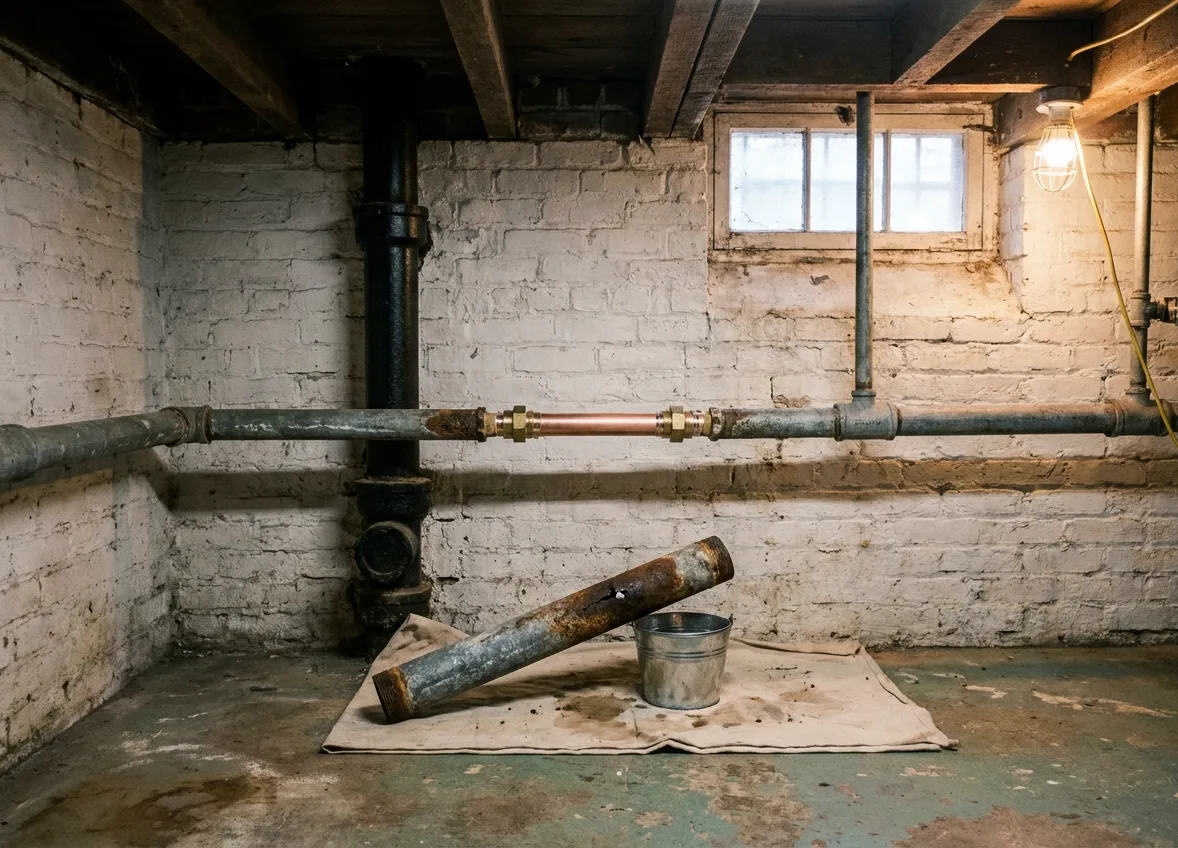
The pipes we repair most often
Galvanized steel supply
Standard in Brooklyn houses built before the war. It rusts from the inside, so it leaks first at threaded joints, where the wall was cut thinnest when it was installed.
Copper supply
Generally long-lived here, but pinholes appear where water turns sharply at fittings, and old joints made with too much flux can corrode from the outside.
Brass
Common in better-built prewar houses. Old brass can lose its zinc and turn brittle and pinkish, cracking at the threads.
Cast iron drain and waste
Stacks crack along a seam or rust through at the bottom where the pipe turns toward the sewer. Sections can be cut out and replaced with modern no-hub pipe.
Repair the spot or replace the run?
This is the decision that matters most, and it depends on the pipe either side of the leak. If the pipe next to the failure is solid, a short replacement section with proper fittings is a permanent fix. If the pipe next to it is just as thin, a patch will hold until the next weak spot a few inches away gives out.
We check that before quoting, usually by looking at the inside of the piece we remove. Heavy rust scale and a narrowed bore tell us the rest of that run is in the same state. At that point Elite Pipe Solutions will tell you so, and explain what replacing the run would involve, instead of selling you a series of patches.
Temporary fixes worth knowing about
If a pipe starts leaking before anyone can get to you, a few things genuinely help:
- Close the nearest valve upstream of the leak, or the main shutoff where the water line comes through the front wall
- Open a faucet on the lowest floor to drain the pressure out of the line
- Wrap a small pinhole tightly with rubber and a hose clamp to slow it down; it is not a repair, but it buys time
- Move anything that can be damaged out from under the leak, and turn off power to any wet electrical fixture
Avoid epoxy putty on a pipe that is still under pressure. It rarely cures on a wet surface, and it hides how far the damage has spread when someone comes to fix it properly.
Pipes inside walls and ceilings
In a brownstone the supply and drain lines often run inside plaster walls that are worth keeping. We open the smallest access we can, as close as possible to the joint we need, and cut plaster cleanly so a plasterer has straight edges to work to. When the pipe can be reached from a closet or the cellar below, we use that route instead.
Related services
Frequently asked questions
How long does a typical pipe repair take?
Replacing a short leaking section that is easy to reach is often done in a couple of hours. Pipes inside finished walls take longer because of the access.
Can you repair a pipe without turning off water to the whole building?
Often yes, if there is a working valve for that line. In older buildings without branch valves we may need to shut a riser or the main briefly, and we can add a valve while we are there.
Is a pinhole leak a sign of bigger problems?
Sometimes. One pinhole in sound copper can be a one-off. Several in the same run, or rust scale inside the pipe we remove, means the run is wearing out.